0086-379-64086155
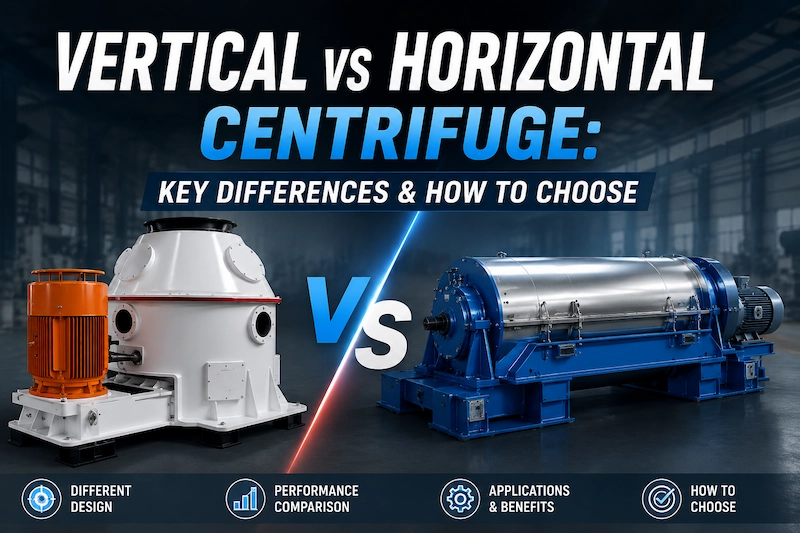
Selecting the right centrifuge can significantly impact separation efficiency, operating costs, product quality, and maintenance requirements. Among industrial centrifuges, vertical and horizontal designs are the two most widely used configurations across mining, chemical processing, wastewater treatment, food production, pharmaceuticals, and oil & gas industries.
Neither design is universally better. A vertical centrifuge generally offers a smaller footprint, simpler installation, and efficient solid-liquid separation for specific materials, while a horizontal centrifuge often provides higher throughput, continuous operation, and greater flexibility for handling large volumes of slurry. The best choice depends on your material characteristics, production requirements, and long-term operating objectives.
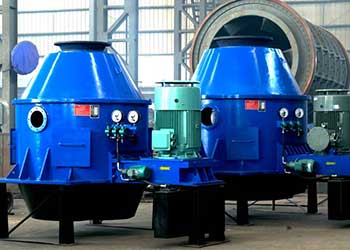
A vertical centrifuge uses a vertically mounted rotating basket or bowl to separate solids and liquids through centrifugal force.
Material enters the centrifuge and is subjected to high rotational speeds, causing denser solids to move outward while liquids are discharged separately.
A modern vertical centrifuge machine is commonly used in:
Coal preparation plants
Mineral processing operations
Chemical manufacturing
Food processing facilities
Pharmaceutical production
Compact footprint
Vertical shaft design
Efficient dewatering performance
Relatively simple structure
Suitable for batch or semi-continuous operation
A horizontal centrifuge uses a horizontally mounted rotating bowl and often incorporates screw conveyors or scroll mechanisms for continuous solid discharge.
Horizontal centrifuges are frequently selected when processing large volumes of slurry or materials requiring continuous operation.
Continuous processing capability
High production capacity
Excellent automation potential
Suitable for difficult-to-separate materials
Widely used in large industrial facilities
| Factor | Vertical Centrifuge | Horizontal Centrifuge |
|---|---|---|
| Installation Space | Smaller Footprint | Larger Footprint |
| Production Capacity | Moderate | High |
| Continuous Operation | Limited | Excellent |
| Initial Investment | Lower | Higher |
| Maintenance Complexity | Lower | Higher |
| Automation Capability | Moderate | Advanced |
| Energy Consumption | Generally Lower | Depends on Throughput |
| Dewatering Performance | Excellent | Excellent |
| Suitable for Large-Scale Plants | Limited | Ideal |
| Operator Requirements | Lower | Higher |
One of the biggest advantages of a vertical centrifuge machine is its space-saving design.
Facilities with limited floor space often prefer vertical systems because they occupy less area while still delivering effective separation performance.
Vertical centrifuges often require lower capital investment than large horizontal systems.
This makes them attractive for:
Small processing plants
Pilot projects
Regional production facilities
Budget-sensitive operations
With fewer moving components, vertical centrifuges are often easier to maintain and troubleshoot.
This can reduce:
Maintenance expenses
Downtime
Spare parts inventory requirements
Many mining and coal preparation facilities utilize vertical centrifuges because of their strong dewatering capabilities.
Compared with large horizontal systems, vertical centrifuges may process lower volumes of material per hour.
Some vertical designs are better suited to batch processing rather than fully continuous production.
Certain highly viscous or difficult materials may be better handled by horizontal centrifuge designs.
Horizontal centrifuges are commonly selected for large-scale industrial operations because they can process significant material volumes continuously.
Industries benefiting from this capability include:
Mining
Wastewater treatment
Chemical processing
Food manufacturing
Oil and gas production
Many horizontal centrifuges feature automatic solids discharge systems, allowing uninterrupted production.
This improves:
Plant efficiency
Labor productivity
Production consistency
Modern horizontal centrifuges are often integrated into fully automated processing lines.
Advanced control systems enable:
Real-time monitoring
Automatic adjustments
Predictive maintenance programs
Remote operation capabilities
Horizontal centrifuges typically involve:
Higher equipment costs
More complex installation
Additional automation systems
Components such as screw conveyors, bearings, and differential drives require regular inspection and servicing.
Facilities must allocate sufficient floor space for operation and maintenance access.
| Industry | Typical Preference |
|---|---|
| Coal Processing | Vertical Centrifuge |
| Mineral Dewatering | Vertical Centrifuge |
| Fine Coal Recovery | Vertical Centrifuge |
| Small Chemical Plants | Vertical Centrifuge |
| Pilot Production Lines | Vertical Centrifuge |
| Industry | Typical Preference |
|---|---|
| Municipal Wastewater | Horizontal Centrifuge |
| Food Processing | Horizontal Centrifuge |
| Oil & Gas | Horizontal Centrifuge |
| Large Chemical Plants | Horizontal Centrifuge |
| Continuous Production Facilities | Horizontal Centrifuge |
Production volume is often the most important factor. Large-capacity plants generally favor horizontal centrifuges.
Facilities with limited floor space may find vertical centrifuges more practical.
Different centrifuge designs achieve different residual moisture levels. Product specifications should be reviewed carefully.
Continuous processing environments often benefit from horizontal centrifuges with automatic discharge systems.
Plants with limited maintenance resources may prefer simpler vertical centrifuge designs.
| Cost Factor | Vertical Centrifuge | Horizontal Centrifuge |
|---|---|---|
| Purchase Price | Lower | Higher |
| Installation Cost | Lower | Higher |
| Energy Consumption | Moderate | Moderate to High |
| Maintenance Cost | Lower | Higher |
| Labor Requirement | Higher | Lower with Automation |
| Long-Term Production Cost | Depends on Scale | Often Lower at High Volumes |
Limited installation space.
Moderate production requirements.
Focus on dewatering performance.
Lower capital budget.
Simplified maintenance priorities.
Coal and mineral processing applications.
Large-scale industrial production.
Continuous operation requirements.
Advanced automation goals.
High throughput demands.
Complex slurry processing applications.
Long-term efficiency optimization.
In many coal and mineral applications, a vertical centrifuge machine can achieve excellent dewatering performance. Actual results depend on material characteristics and operating parameters.
Vertical centrifuges generally feature simpler mechanical designs and lower maintenance complexity.
Yes. Continuous operation is one of the primary reasons large industrial facilities choose horizontal centrifuges.
For high-volume facilities, horizontal centrifuges often generate stronger long-term returns through increased productivity. Smaller plants may achieve faster payback with vertical centrifuge systems due to lower upfront costs.
Both vertical and horizontal centrifuges offer valuable advantages, but the ideal choice depends on your application, production volume, available space, budget, and maintenance capabilities.
A vertical centrifuge machine is often the preferred solution for coal preparation, mineral dewatering, and facilities seeking compact equipment with lower investment costs. Horizontal centrifuges excel in large-scale continuous operations where automation, throughput, and process efficiency are top priorities.
Before making a purchasing decision, operators should evaluate not only equipment specifications but also long-term operating costs, spare parts support, maintenance requirements, and expected production growth. A properly selected centrifuge can deliver years of reliable performance while maximizing separation efficiency and overall plant profitability.


Contact Us
 English
  日本語
日本語  français
  Deutsch
  Español
  italiano
  русский
  português
  العربية
  română
  Nederland


 日本語
日本語